Warranties, Receipts and Manuals Worth Keeping
Most household paperwork earns its place for a few years, then quietly stops being useful. Here is how to tell the difference before the drawer fills up again.
By the editors · 6 min read
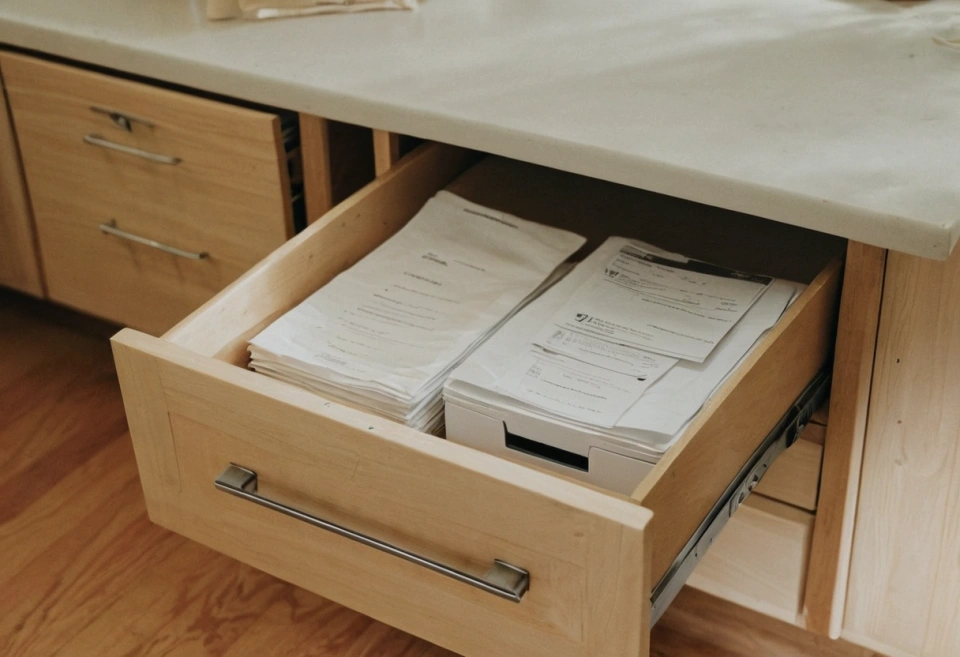
The kitchen drawer that holds appliance papers usually holds three different kinds of thing at once: proof that something was bought, the terms under which someone promised to fix it, and instructions for using it. Those three have very different lifespans, and mixing them is why the drawer becomes impossible to search. Sorting by purpose rather than by item makes the pile smaller, easier to label and far easier to thin out later.
Three kinds of paper, three different clocks
Proof of purchase is the receipt, the order confirmation email, the invoice from whoever installed the thing. It matters most in the first weeks, when a return is still possible, and again if a claim needs evidence of when the item entered the house. Coverage terms are the warranty booklet or the printed sheet that came in the box. Instructions are the manual, useful for as long as the appliance is in service and useless the day it leaves.
Once those are separated, the decisions get simpler. A manual for a dishwasher that went to the curb has no reason to exist. A warranty booklet for a range still in the kitchen does, but only until its coverage runs out. A receipt sits somewhere between: valuable while a claim is plausible, worth keeping longer for anything fixed to the house, disposable for a kettle bought several summers ago.
There is a fourth category that people rarely name, and it causes most of the clutter: paper kept out of vague worry. Registration cards already sent, packaging inserts, promotional leaflets, the folded diagram showing which screw goes where in a bookcase assembled long ago. None of these answer a question anyone will ask. They can go straight into recycling without further thought.
Labelling so the drawer can be searched
A file only works if someone other than the person who filed it can find something. That means labels written for a stranger, or for yourself in a hurry with a repair technician on the phone.
Use one envelope or folder per item, and write four things on the front:
- What it is, in plain words, including the brand and model if you have them.
- Where it lives in the house, such as basement laundry or upstairs hall closet.
- When it was bought; month and year is enough.
- When the coverage ends, or the word unknown if you genuinely cannot tell.
That last line does more work than the others. It turns the folder into something you can act on without opening it, and it makes the annual clear-out a matter of reading fronts rather than rereading contents. Write in pencil or on a strip of removable tape, because coverage dates sometimes get corrected later.
Inside the envelope, put the receipt first, then the coverage terms, then anything else. Staple the receipt to a plain sheet of paper so the thermal printing does not rub away against its neighbors, and so a small slip does not vanish into the fold of a booklet. If the receipt arrived by email, print it or save it in a folder with the same name as the paper one. Matching names across paper and screen is the whole trick to a hybrid system.
For households already keeping a central file, these envelopes belong in it rather than in a separate drawer. The structure described in a family binder for the house handles appliance papers well, since the same section can hold installer contacts and service records alongside the purchase documents.
Photographing serial numbers properly
Serial numbers live in awkward places: behind the kick plate, inside the door frame, under the lip of a machine that has to be pulled out. Writing them down at installation saves an unpleasant afternoon later.
Take three photographs of every significant appliance. The first is the whole item in its place, so the picture identifies itself. The second is the rating plate, close enough that every character is legible, with the flash off and the light coming from the side so embossed text casts a shadow. The third is the receipt laid flat next to that plate, or held in the same frame if the geometry allows. A receipt without a model number is hard to use, and a model number without a receipt is hard to prove, so keep them together.
Check each photograph before moving on. Blurry plates are common and almost always discovered too late. If the characters will not resolve, type them into a note as well, then read the note back against the plate one character at a time. Transposed letters are the usual failure.
Name the image files the way the envelopes are named, and store them in a folder that gets backed up along with everything else. A phone alone is not a filing system. For anyone building a fuller record of the house, this pairs naturally with making a home inventory room by room, where the same walk through the rooms can capture plates, receipts and condition in one pass.
Knowing whether something is still covered
Coverage is rarely a single tidy period. Manufacturer coverage on the whole appliance, longer coverage on a specific sealed component, and a separate plan bought from a retailer can all apply to the same machine, each with its own start date and conditions. Some begin on the purchase date, some on the delivery date, some on the date of registration.
Rather than memorize this, write a short summary on the front of the envelope or in a note attached to the photographs: what is covered, until when, and what the provider asks for before they will act. Many plans require registration within a limited window, proof of purchase, and service by an authorized provider. Some exclude damage from installation or from lack of maintenance. Reading those conditions once, calmly, at the time of purchase is far easier than reading them during a leak.
When something breaks, check the summary before calling anyone. If the answer is unclear, contact the manufacturer or plan provider using the details on their own documents and ask them to confirm the status in writing. Terms vary widely between providers and between states, and for anything involving significant cost, insurance claims or a dispute over responsibility, check the specifics with a qualified professional rather than relying on general guidance.
Letting old paper go
Paper earns its space by answering a question you might actually ask. Once coverage has ended and the item is old enough that a claim is implausible, the receipt and the warranty booklet have finished their work. Keep the manual if the appliance is still running, since filter sizes and error codes remain useful. Discard the rest.
For items still in the house with expired coverage, keep a single slim record: the photograph of the plate, the purchase date, and any service history. That is enough for a repair conversation and takes almost no room.
Receipts fade. Thermal paper goes blank in a warm drawer, sometimes within a couple of years, another argument for photographing them early rather than trusting the original. Shred anything carrying an account number, a card fragment or a signature before it leaves the house. Plain manuals and warranty booklets can go into paper recycling without ceremony.
Set a recurring moment for this, tied to something already happening: the change of season, the week the smoke alarm batteries get tested. Read the fronts of the envelopes, pull the ones whose coverage has lapsed, and empty them. The drawer shrinks in a few minutes rather than a weekend.
Start with one appliance
Pick the machine most likely to cause trouble, usually the washer or the furnace, and give it a proper envelope today. Find the receipt, photograph the plate, read the coverage terms once and write the end date on the front. Then look at what remains in the drawer and notice how much of it belongs to nothing in particular. That comparison is the clearest argument for finishing the job, one appliance at a time, over the next few evenings.