The Corner Desk That Shares a Room With Everything Else
A desk in a shared room works when its edges are clear: where it sits, what the light does, who may touch it, and when the day ends. Here is how to settle all four.
By the editors · 6 min read
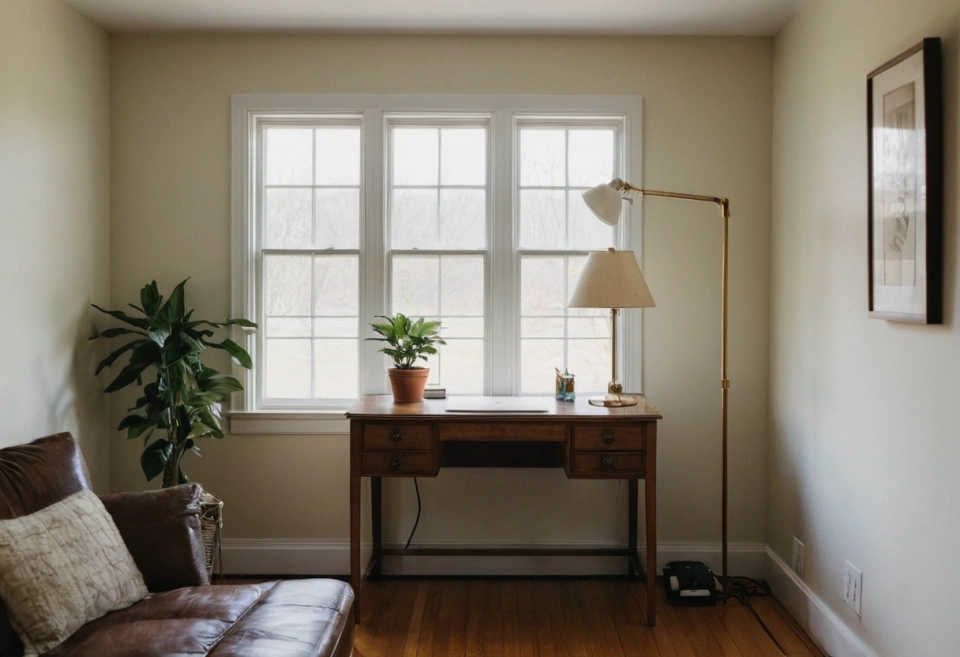
A desk in the corner of a living room or bedroom has to do two jobs at once: hold a working day, then get out of the way of dinner, homework and television. Most households manage this badly at first, not because the desk is wrong but because nobody decided where it belongs, what the light does late in the afternoon, whose cables those are, and when work is officially finished. This piece settles those questions in order, so the corner stops being a source of low-grade friction.
Choosing the corner before buying the desk
Walk the room the way your household actually walks it: from the door to the sofa, from the kitchen to the stairs, from the hallway to the bathroom at night. The desk should be reachable without crossing the main path through the room, because a workspace people walk past all evening never feels settled. Corners near a doorway tend to fail. Corners at the far end of a room, behind the seating rather than beside it, tend to work.
Stand in the candidate spot and turn a slow circle. Note what would appear on a video call: a laundry pile, a bookshelf, a blank wall. A plain wall or a curtain is kinder than an open kitchen. Then check the practical things. Is there an outlet close enough that no cord has to stretch across a walkway? Is there room for a chair to roll back without hitting a coffee table? Does the corner block a closet, a radiator or a window someone opens every morning?
Measure with your body if you have no tape handy. Sit down, push back as though standing up, and see whether you strike anything. A desk that fits the wall but not the sitting is not a fit.
Light that works morning and late afternoon
Daylight from the side is the most forgiving arrangement. Facing a window puts a bright rectangle behind everything you look at; backing one puts your reflection on the screen. Sitting beside the window, glass to your left or right, gives even light on papers and no glare worth fighting.
Watch the corner at the hour you find hardest, usually late afternoon. Low sun can wash out a screen entirely, and a thin curtain or an adjustable blind solves it more cheaply than moving furniture. Overhead fixtures alone rarely suffice for reading small print, so plan on a task lamp with an arm you can bend toward the page rather than toward your eyes. Warm light in the evening keeps the corner from feeling like an office after everyone else has gone soft and sleepy.
If the room has only one good window and the family wants it, take the second-best light and a better lamp. Households run on goodwill more than on ideal placement.
The chair, the surface, and the height of things
A dining chair is fine for an hour and punishing for a full day. Look for a seat that lets your feet rest flat, a back that meets the small of your spine, and armrests low enough to slide under the desk. Height matters more than padding: elbows roughly level with the work surface, shoulders relaxed, wrists straight rather than bent upward.
Most desks are built slightly too high for shorter adults. A footrest, even a firm box or a stack of books wrapped in cloth, restores the geometry. Raising the screen so its top edge sits near eye level saves the neck; a laptop stand plus a separate keyboard does more good than any expensive accessory.
Give the surface a border. Papers, pens and the day's notebook live on the desk; everything else lives in a drawer, a basket underneath, or elsewhere in the house. When the whole surface becomes storage, work spreads sideways into the room and never quite ends.
Cables, power, and the small hazards underfoot
Cords are the part of a home office most likely to annoy someone who does not work there. Route them along the wall or the back edge of the desk, gather the slack with reusable ties, and lift them off the floor wherever a vacuum or a toddling child will find them. A power strip fixed to the underside of the desk keeps plugs reachable and out of sight.
- One strip for the desk, labeled, with nothing else plugged into it downstream.
- Charger cables coiled and clipped when not in use, not left dangling.
- Nothing running under a rug, where heat builds and wear goes unseen.
- No cord crossing a walkway, even temporarily, if a household member uses a walker or moves quickly at night.
Do not daisy-chain strips or run high-draw appliances from the same outlet as your equipment. Older homes vary widely in what their circuits can carry, and rental wiring is not always what it appears to be; for anything involving load, outlets, or added fixtures, check the specifics with a qualified electrician rather than guessing. Where children or pets share the room, keep adapters and small connectors above their reach.
Noise, and the agreements that matter more than headphones
Headphones help the person wearing them and do nothing for the person trying to watch a show a few feet away. The durable fix is a schedule and a signal. Agree on the hours when the corner is a workplace, and agree on what silence means during them: no calls nearby, or conversation allowed but no interruptions unless something is bleeding or burning.
A closed door is the clearest signal, which is why a room with one is worth some inconvenience elsewhere in the house. Without a door, use an object: a small sign, a lamp switched on, headphones visibly worn. Children accept arbitrary rules readily when the rule is consistent and applies to everyone. Let them interrupt for real needs and teach the difference between urgent and interesting.
Calls are the sharpest edge. Take them elsewhere in the house when you can, and keep earbuds by the desk so a sudden meeting does not become a household event. If work involves clients, inventory, or anything beyond ordinary employment, the boundaries deserve more thought; our guide to running a small business from home without swallowing the house covers doors, storage, and the parts of a business that should not live on the kitchen table.
Closing the day, then handing over the desk
A corner desk earns its keep by disappearing politely at the end of the day. Decide what finished looks like and make it physical: laptop closed and set on a shelf, notebook shut, papers stacked in one tray, lamp off, chair pushed in. Two minutes, the same two minutes every evening. The point is not tidiness for its own sake; it is that a visible open laptop keeps asking to be checked.
Write tomorrow's first task on a slip of paper before you close the notebook. Unfinished work nags less when it has somewhere to wait. Then leave the corner. Eat somewhere else. Resist the pull of one more email while the pasta water heats.
Homework gets its own claim on the surface. Give each child a tray or folder that holds their current work, and give them an hour when the desk is theirs and the work laptop is elsewhere. Clear the desk completely before the handover so nobody has to work around a stranger's paperwork. Keep school supplies in a separate container from office supplies; mixed pens are a small thing that produces disproportionate irritation.
Paperwork that arrives through work or school needs a destination outside the corner. Receipts, manuals, warranty cards and the like belong in a household file rather than a desk drawer; see warranties, receipts and manuals for what is worth keeping and how to label it. Anything touching taxes, insurance, contracts or deductions should go to a qualified professional, not to a shoebox under the printer.
Start with one evening
Pick the corner tonight and sit in it for a few minutes at the hour you usually work. Notice the light, the noise, the path people take past your shoulder. Move the desk if the answer is wrong; it is easier now than after the shelves go up. Then choose your closing ritual and your homework hour, say both out loud to the household, and try them for a week. Adjust what rankles. A shared room can hold a working day and a family evening, provided everyone knows where one ends and the other begins.